Router-cut, V-cut and combined-type automatic board dividers for the PCBA process.
A board splitting machine (depaneling machine) separates many individual boards from a panelised sheet at the same time, raising production efficiency. Machine types include router processing, dicing, stamping and press-cutting.
Printed circuit boards use glass, composite or paper base materials; depending on the machine, all base materials can be processed.
A rotating router bit cuts the board apart along the desired path.
A rotating abrasive wheel cuts the board at the specified position.
A cutting die matched to the board's dividing lines separates the boards in a single press stroke.
For small production volumes, the board is passed between upper and lower rotating circular blades and separated by the blade gap.
1. Router splitting: boards 0.4mm–2mm thick can be divided in vertical, horizontal and diagonal directions. Entering the cutting coordinates at the terminal makes board changeover easy, but router processing produces a lot of dust — know-how is required for jig design and the dust vacuum system. Fibre whiskers appearing on the cut face can be reduced by cutting twice. Component height on the board is limited and cutting speed is relatively slow.
2. Stamping: all dividing positions on a sheet are cut simultaneously in one shot, so separation is very fast, even with tall components. Little dust is produced, making it suitable for high-volume production. However, the cutting die is expensive to produce, and the stress applied to the board during splitting is high, which can affect board quality.
3. Press-cutting: suitable when production volume does not justify the larger initial investment of router or stamping machines. Not suitable for paper-based boards.
Panelised boards use either V-groove or perforation (mouse-bite) dividing patterns. KTI provides automatic splitting machines for perforated boards, V-cut grooved boards, and combined boards mixing perforation and V-cut splitting.
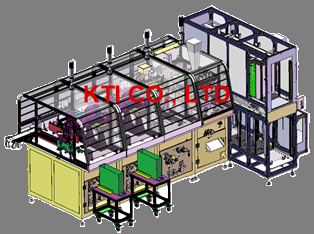
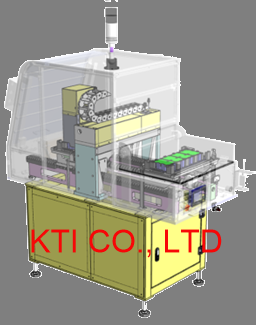
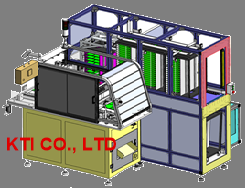
Router-type splitting machine for perforated PCB panels
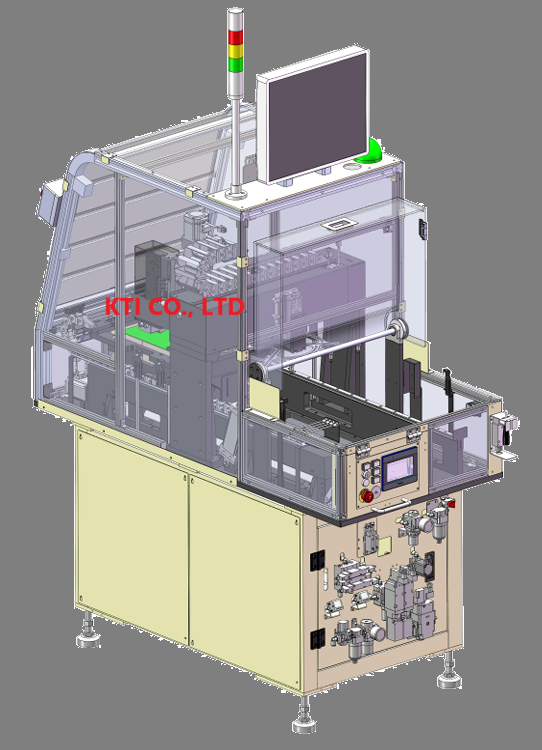
| Item | Specification |
|---|---|
| Model | AM-455-Ⅱ |
| Dimensions | 1250mm(L) × 600mm(W) × 1500mm(H) |
| Weight | 200kg |
| Rated voltage | 3-phase, AC380V, 50Hz |
| Rated power | 3kW |
| PCB size | ≤400mm(L) × 350mm(W) × 3mm(H) |
| PCB materials | Paper-phenol, glass-composite, glass-epoxy, flexible and PTFE (fluorine) boards, etc. |
| Router bit diameter | φ0.8–φ3.0mm |
| Positioning accuracy | ≤0.02mm |
| Travel speed | Max. 1000mm/sec |
| Z-axis stroke | Max. 70mm |
| Spindle speed | 5,000–60,000rpm |
| X, Y, Z axes | AC servo motors |
| Air supply | ≥0.4MPa |
| Air consumption | ≤20–30L/min (A.N.R.) |
Enter your account to access the internal management portal.